
Article: Laura Critchlow RSM: Capturing a Moment in Time
Laura Critchlow RSM: Capturing a Moment in Time
There is something almost meditative about standing in front of a Laura Critchlow painting.
An orange catches the light. A glass bowl reflects its surroundings. The flame of a candle illuminates the fruit beside it. More recently, peonies and other flowers have begun to tumble into her compositions, each petal rendered with the same extraordinary precision.
At first glance, Laura's paintings are celebrations of beauty and technical skill. Spend a little longer with them, however, and there is something deeper at work.
They are paintings about observation, patience and, perhaps most importantly, time.
We recently sat down with Laura at Jarva Gallery to talk about the journey that has taken her from a creative childhood in Buxton, through careers far removed from the art world, to exhibiting with some of Britain's most respected artistic institutions and ultimately becoming a full-time professional artist.
And, as we discovered, none of it happened quite as conventionally as you might expect.
A Creative Childhood in Buxton
Although Laura wasn't technically born in Buxton, she has a fairly convincing claim to being a Buxton artist. She returned to the town with her family at around eighteen months old and grew up and went to school here.
There wasn't an obvious artistic career waiting for her at home.
Her parents weren't painters, although creativity was always encouraged. Laura remembers her mother's wonderfully simple solution whenever she and her brother announced that they were bored: the "make-it bag".
It contained anything that might be useful for making something, cardboard, plastic, household odds and ends and the instruction was essentially to go away and create.
Looking back, Laura believes having the opportunity to simply be bored was important.
Without phones and screens constantly providing entertainment, she had time to discover what held her attention. For Laura, that often meant drawing.
She distinctly remembers repeatedly copying a teddy bear from a book. If it wasn't right, she drew it again. And again.
It is a small childhood memory, but listening to Laura tell the story, it is difficult not to recognise the artist she would eventually become.
That willingness to repeat something until she understands it but to paint not one apple, but potentially a hundred before feeling she has truly captured it still sits at the heart of her practice today.
Music, Discipline and the Old Masters
Art wasn't Laura's only creative influence.
Her grandfather was a professional jazz musician and introduced Laura and her brother to music from an early age. She learned to read music and joined the brass band at around nine or ten years old, beginning an involvement with music that would continue for decades.
There is an interesting parallel between the two disciplines.
Learning an instrument requires repetition. Improvement rarely happens overnight; it happens almost imperceptibly through years of practice.
Painting, Laura believes, is much the same.
That discipline became particularly important when she discovered the artists who would profoundly influence her.
Visits to major galleries in London and Manchester introduced her properly to the Old Masters. Seeing paintings she had previously only encountered reproduced in books was transformative.
Caravaggio in particular left an enormous impression, alongside Artemisia Gentileschi and the dramatic use of light found throughout the work of the Old Masters.
But another pivotal moment happened somewhere considerably less grand.
Laura and her husband Steve were walking through Sheffield when she spotted a still life in the window of a gallery.
It showed two red apples against a dark background.
She can still visualise it.
The realism was so convincing that the apples appeared almost capable of falling out of the painting.
For Laura, it was a lightbulb moment.
That was what she wanted to be able to achieve.
Not simply painting an apple, but creating such a convincing sense of light, form and presence that the viewer momentarily forgets they are looking at paint.
The Career That Nearly Didn't Happen
Perhaps one of the most surprising parts of Laura's story is that art wasn't her first career.
In fact, as a child she remembers saying that she would love to become an artist, only to be given the impression that art wasn't really a "proper job".
At secondary school, despite loving art and design, she didn't continue with it academically.
Instead, Laura studied health and social care before eventually working within occupational therapy services in a secure mental-health setting.
She remained there for thirteen years.
It was challenging work, but also incredibly formative.
Art occasionally found its way back into her working life through therapeutic activities with patients. Laura remembers one woman with dementia who would normally wander throughout the day sitting and drawing for almost an hour.
What struck Laura was that dementia had, in one very small respect, removed an inhibition.
The woman wasn't worried about whether the drawing was good.
She simply drew.
That experience, alongside many others from those years, stayed with Laura.
Later she moved into education, becoming a school secretary and eventually taking responsibility for much of the school's business management, budgeting and administration.
It might appear completely disconnected from painting.
Laura sees it differently.
Her years working with people taught her lessons she will never lose, while managing the business side of a school gave her practical skills that became invaluable when she eventually became self-employed.
And throughout every one of those careers, one thing remained constant.
She never stopped painting.
A Second-Hand Book That Changed Everything
Then came one of those wonderfully accidental moments that only seems significant when you look backwards.
Laura found a second-hand book about miniature painting.
She became fascinated.
That discovery led her to the Royal Society of Miniature Painters, Sculptors & Gravers and Laura began experimenting seriously with painting on an extraordinarily small scale.
In 2014, she submitted her first miniature.
It was accepted.
That alone was difficult for Laura to believe.
Then she travelled to London with Steve and their daughters to see it hanging at the Mall Galleries, and discovered that it had sold.
It was effectively the first painting Laura had publicly exhibited beyond friends and family.
Her immediate reaction?
Surely somebody she knew had bought it.
They hadn't.
A complete stranger had seen something Laura had created and decided they wanted to spend their own money on it and live with it.
For an artist who admits to experiencing more than a little imposter syndrome, it was an extraordinary moment.
Laura continued submitting work and in 2016 was elected an Associate Member of the Royal Society of Miniature Painters, Sculptors & Gravers.
Normally an artist must then submit for several further years before progressing to full membership.
Laura was fast-tracked.
In 2018 she became a full member.
From Imposter Syndrome to the Royal Academy
By this point, painting was taking an increasingly important place in Laura's life.
She began entering respected open exhibitions and something interesting kept happening.
The paintings kept getting accepted.
Some began receiving awards.
One of her portraits was selected for exhibition at the National Portrait Gallery, an experience made even more special when Laura was able to take her parents to see it.
Gradually, the evidence became difficult to ignore.
Perhaps she really could do this.
One exhibition, however, remained firmly at the top of Laura's list: the Royal Academy Summer Exhibition.
She submitted year after year.
Six or seven attempts followed without success.
Then it happened.
A Laura Critchlow painting was accepted into the Royal Academy Summer Exhibition.
Since that first acceptance, further works have followed and her pieces have repeatedly sold during the exhibition.
For Laura, those selections represented more than prestigious lines on an artist biography. They helped silence the voice that had spent years telling her that because she hadn't attended art school or university, she somehow wasn't a "real" artist.
What that voice had conveniently ignored was decades of painting.
Decades of looking.
Decades of practising.
And thousands upon thousands of tiny decisions made in front of an easel.
Painting One Orange
Ask Laura why she continues to paint fruit and her answer tells you almost everything you need to know about her work.
Someone once asked her how many more oranges she could possibly paint.
Her answer, essentially, is limitless.
Because she isn't painting an orange.
She's painting that orange.
That particular piece of fruit grew once. It existed in that particular form for a remarkably short period of time. Perhaps only the person who picked it, someone who handled it in a supermarket and Laura herself ever really looked at it.
Then it changes.
For Laura, painting becomes a way of preserving that moment.
The same fascination is now flowing into her increasingly ambitious floral paintings.
A flower opens once.
That particular arrangement of petals, colour and light will never exist again in precisely the same way.
Laura describes having an awareness, almost an anxiety, around time and its passing. Her earlier career, where ageing, dementia and death were unavoidable realities, perhaps heightened something that was already there.
She recalled hearing art described as "the ultimate immortality project" – the idea that an artist creates something capable of continuing long after they have gone.
It clearly resonated.
Suddenly those immaculate oranges, flowers and flickering candles feel slightly different.
They aren't simply still life paintings.
They're moments that Laura has refused to allow to disappear.
Three Colours, Endless Possibilities
The complexity of Laura's paintings makes one detail about her technique particularly surprising.
Many of her still lifes are created from essentially three colours plus white.
Working predominantly from primary colours allows Laura to mix and remix the tones she needs while maintaining harmony throughout the painting.
As flowers have entered her work, the palette has begun expanding slightly, certain pinks and additional colours becoming necessary, but the discipline remains.
And Laura deliberately keeps making things harder for herself.
Once she feels comfortable painting a particular subject, the question becomes: what can I introduce that will challenge me now?
A candle creates another light source and a completely different set of reflections.
Glass introduces transparency and distortion.
A flower might contain dozens upon dozens of individual petals.
For some artists, mastering something might be the destination.
For Laura, it simply creates the starting point for the next problem.
The Painting That Started a New Chapter
There is another side to Laura's work that feels like the beginning of an exciting new chapter.
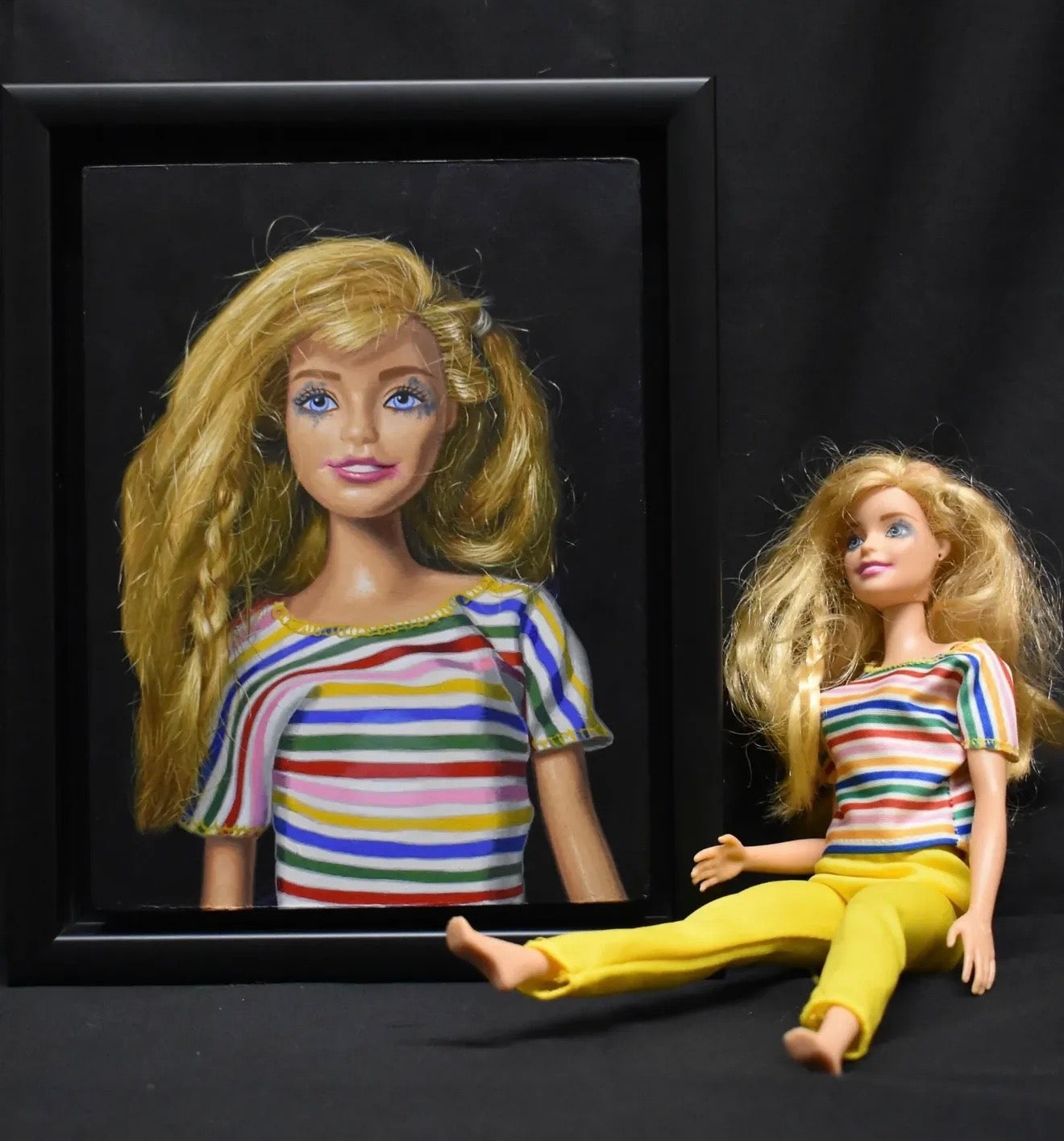
Alongside her celebrated still lifes sits a single, striking Barbie painting, created especially for this year's Royal Academy Summer Exhibition.
Its inspiration reaches back centuries.
During our conversation, Laura spoke passionately about the seventeenth-century painter Artemisia Gentileschi, whose life and work left a lasting impression on her. Gentileschi painted women with strength, anger and agency in a world that rarely afforded them the same recognition as men. That story stayed with Laura.
Her response was unexpectedly contemporary.
Using Barbie as a symbol of femininity, Laura created a work that explores beauty, expectation, frustration and female strength, a painting that feels both playful and quietly defiant.
The response has been extraordinary.
After the painting was selected for the Royal Academy Summer Exhibition, Laura was invited to London by the Royal Academy for a filmed interview discussing the work and the ideas behind it. Since then, the interview has reached an enormous audience online, and Laura has been inundated with messages from people asking whether more Barbie paintings will follow.
Until now, there has only been one.
That is about to change.
Laura has agreed to create a carefully selected collection of new Barbie works exclusively for Jarva Gallery, which we will unveil at Manchester Art Fair this November.
As a female-founded and female-led gallery, this feels incredibly significant to us. Art has the power to spark conversations as well as admiration, and we're honoured that Laura has trusted us to introduce this important new chapter of her work.
Becoming a Full-Time Artist
The final push towards becoming a professional artist came, unexpectedly, during Covid.
The Artist Support Pledge gave artists a way of selling smaller, affordable works directly at a time when galleries and exhibitions had closed.
Laura's miniature paintings proved enormously popular.
She found herself unable to paint them quickly enough.
More importantly, it demonstrated something practical: there was a genuine market for her work.
When galleries reopened, Laura's career continued to grow and eventually, in 2023, she became a full-time artist.
Today she prefers working with galleries rather than handling every aspect of selling herself.
She knows where she is happiest.
At the easel.
A typical day might involve two hours painting in the morning, another session later and then, one of her favourite times, painting quietly in the evening.
Altogether she aims for around six hours.
It is mentally exhausting work.
Hyperrealism demands constant observation, problem-solving and decision-making. Laura has learned when her concentration has reached its limit and when it is time to walk away.
Then she comes back and begins again.
What Comes Next?
Flowers are currently providing Laura with an entirely new world to explore.
Inspired partly by seeing historic Dutch floral paintings, she is becoming increasingly ambitious with scale and composition – glass vessels, tumbling arrangements, seasonal flowers and the tiny insects that sometimes hide amongst them.
And yet fruit isn't disappearing.
Nor, we suspect, is Barbie.
That is perhaps what makes this particular point in Laura's career so exciting.
The technical ability is already extraordinary. The recognition is there. Her paintings have appeared in some of the country's most prestigious exhibitions.
Now we're beginning to see even more of the person behind them.
Laura told us that if she ever looked at one of her paintings and thought she'd completely nailed it, it might be time to put the brushes down.
Because perfection isn't really attainable.
There is always another painting.
Another challenge.
Another orange.
Another flower.
Another fleeting moment worth holding onto.
And we can't wait to see what she captures next.
Discover Laura Critchlow at Jarva Gallery
We are incredibly proud to represent Laura Critchlow here in her home town of Buxton.
To experience the extraordinary detail in Laura's paintings properly, they really do need to be seen in person. Visit Jarva Gallery to discover her latest available original works, or explore the collection online.
For information about available paintings or future works by Laura Critchlow, please contact the gallery.

